How to Build a WhatsApp Lead Generation Funnel That Converts
A business owner runs an ad for one week. The phone receives messages such as "Price?" and "Details, please." After three days half of those chats are. No one remembers who asked for what.
The ad worked. The funnel did not.
WhatsApp lead generation is not about getting people to message you. It is about what occurs in the minutes, hours and days after that message. Who replies? What do they ask? Where does the information go? Who follows up? When?
In this guide you will walk through the journey step by step: advertisement, enquiry, qualification, CRM and sales follow-up. You will also see what each step looks like for a local business so you can copy the idea and adapt it.
What is a WhatsApp lead generation funnel?
A funnel is the path a stranger follows to become a paying customer. In this case WhatsApp is the place where that path takes place.
Someone sees your ad. Taps a button. A chat opens. They answer a question. Your team follows up. A days later they make a purchase.
It is called a funnel because you begin with people at the top and finish with fewer at the bottom. That is normal. The goal is not to stop people from dropping off. The goal is to make sure the right people do not drop off for the reasons, such as a slow reply or a forgotten chat.
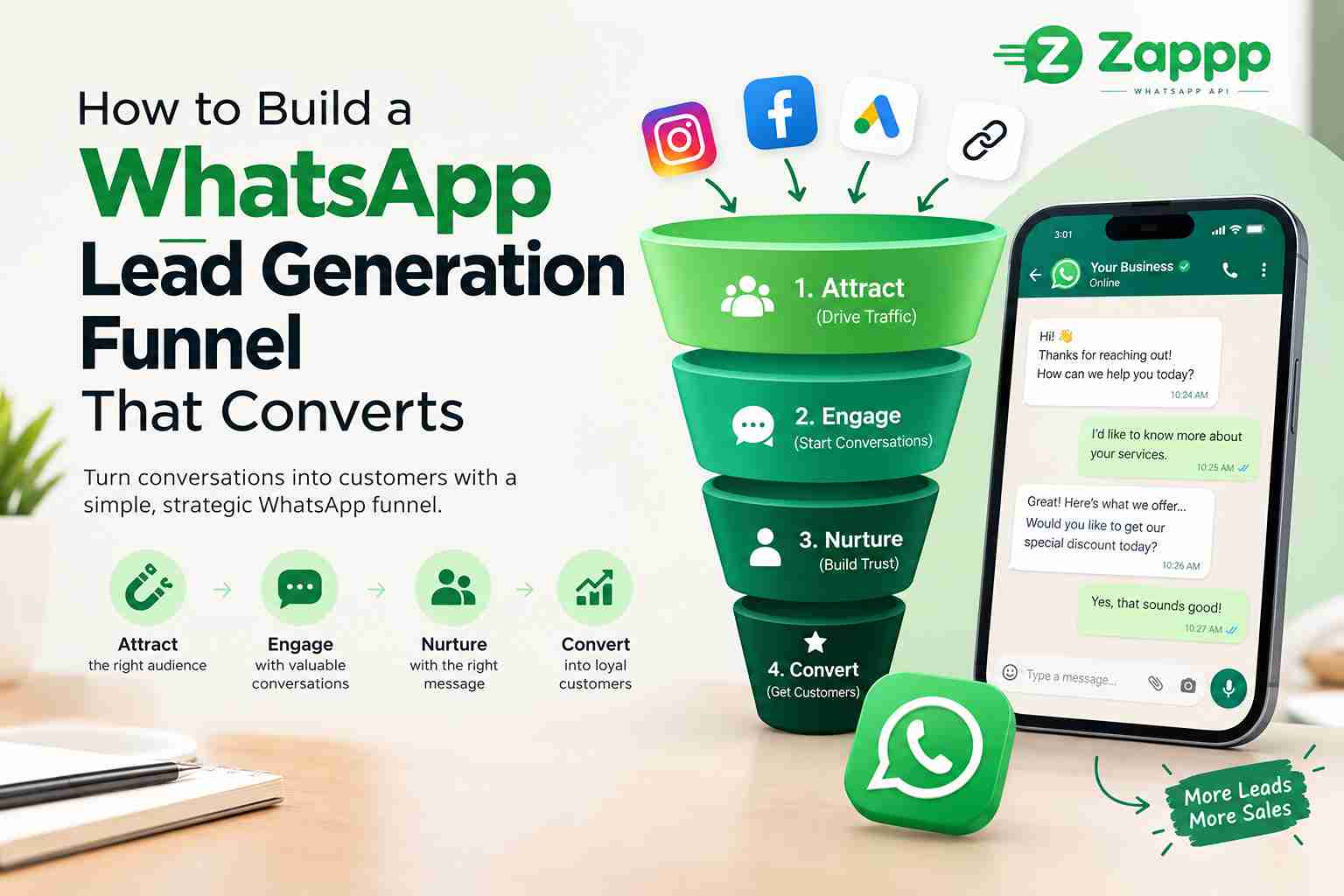
Every step in the funnel has one job:
- Attract: get people to message you on WhatsApp
- Respond: reply and start the conversation
- Qualify: find out who is a real buyer
- Organise: save every lead in a CRM
- Follow up: stay in touch until they decide
- Close: make buying simple
If one step is weak leads leak out at that point. Let us fix them one by one.
Why WhatsApp works well for lead generation
Think about how you would rather contact a business. A phone call can feel like a step. An email might go unread. A form on a website feels like paperwork.. A WhatsApp message takes ten seconds and everyone already has the app open.
That is why many customers in Cuttack, Bhubaneswar and across Odisha now message first and call later. They can ask a question at 10 pm share a photo and receive a reply without any pressure. For a business this means enquiries.. It also means more chats to manage which is why a clear funnel matters.
Step 1: Bring people to WhatsApp
Your funnel starts before the chat begins. People need a reason to message you and an easy way to do so.
Here are the useful entry points:
- Click-to-WhatsApp ads. These are ads on Facebook and Instagram with a "Send message" button. The person taps the ad and a WhatsApp chat opens immediately. There is no landing page and no form to fill which is why they work well for local businesses.
- A WhatsApp button on your website. Many visitors read a page. Leave. A floating button lets them ask a question then while they are still interested.
- QR codes in the real world. Put one on your shop board, pamphlets, hoardings, product packaging, bills or table tents. Someone walking past can scan it. Start a WhatsApp chat in seconds.
- Instagram and social media links. Add a WhatsApp link to your bio, story highlights and posts so every bit of content has a next step.
- Offline word of mouth. Even a simple line such as "Message us on WhatsApp for a quote" on your invoices or visiting cards can bring in steady leads.
Make the first message ready
Here is a small trick that makes a difference. Set up a pre-filled message that appears in the chat box when people tap your link. For example.
“Hi, I’d like to know more about the free demo class.”
This does two things. It saves the customer from typing. It tells you exactly which ad or offer they came from. If you use a pre-filled message, for each ad you will quickly see which one brings the best leads.
Write ads that bring the people
A WhatsApp ad is not a place for tricks. Be clear. Tell people what you offer, who it is for and what will happen when they tap.
Weak: "Best interior designers in town." Better: "Get a free 3D design for your living room. Message us on WhatsApp.”
The second example gives people a reason to tap. It attracts people who truly want that service. That creates a lead even if the number of leads is smaller.
Step 2: Reply in seconds not hours
This is the step where most small businesses lose the sale.
A person who messages you is interested now. Maybe they are on a break. Maybe they are comparing three shops at once. If you reply after an hour they may already have moved on. Replying fast is one of the ways to improve results because it needs no extra ad spend at all.
An automatic first reply solves this problem. Even if your team is busy, asleep or in a meeting the customer receives an answer. It tells the customer that you are active. It keeps the conversation going.
Keep it short, warm and useful:
“Hi! Thanks for your interest in Bhanja Interiors. I’ll ask two questions so we can help you better.”
Notice that the reply does not try to sell anything. It simply welcomes the person. Leads them into the next step.
A tip for a good first reply:
- Use the customer’s name if you have it.
- Say who you are so the customer knows you are in the right place.
- Don’t send a large block of text; two or three lines are enough.
- Give one clear next step, such as a question or a button to tap.
Step 3: Qualify the lead
Here is a truth about enquiries: not all of them are buyers. Some are only curious. Some are outside your delivery area. Some have a budget that does not match what you offer. If you treat all of them the same, your team will spend hours on chats that never lead anywhere.
Qualification means asking smart questions early so you can tell serious buyers from casual browsers. It is not about being rude or turning people away. It is about giving your attention to the people who need it most.
Three or four questions are usually enough:
- What do you need? This tells you the product, service or package they want.
- Where are you? This helps you check if you can serve them.
- When do you need it? "This week" is a different lead from "just exploring.”
- What range are you comfortable with? Only ask this if it genuinely helps you filter.
Make it easy to answer. Numbered replies and buttons are faster than typing. Most people will tap an option before they write a sentence.
A real example
Take a real estate agent in Cuttack. After an enquiry, the chat asks: "Are you looking to buy or rent?" "Which area do you prefer?" "When are you planning to move?”
In under a minute, the agent knows exactly who is serious. Someone who says "buy, Badambadi area, month" gets a personal call right away. Someone who says "just looking, no plan yet" goes into a lighter follow-up.
Score your leads
Once you have the answers, sort each lead into a group:
- Hot: knows what they want and needs it soon. Contact them personally today.
- Warm: interested, but still comparing. Send information and follow up in a day or two.
- Cold: early stage or just browsing. Keep in touch with useful messages.
You do not need a scoring system. Three groups are enough to decide who gets your time first.
Step 4: Move every lead into a CRM
This is where many funnels quietly break.
The lead answers all your questions. Great.. The details now sit inside a long chat thread. A week later, a new message. Nobody remembers what the person asked for or who spoke to them last. The lead goes cold, not because the person lost interest. Because you lost track.
A CRM solves this problem. A CRM means a customer relationship manager. In one place, a CRM holds every lead with the lead’s name, number, answers, source, and status. A WhatsApp CRM keeps all this next to your chats so you do not have to copy details into a sheet.
Here is what a good CRM setup includes:
Tags. Short labels such as "Lead," "Site visit booked," or "Asked about demo." With tags you can find the people in seconds.
Stages. A simple pipeline, like New Qualified, In discussion, Won and Lost. Stages let you see at a glance how many leads are at each point.
Owner for each lead. One person is clearly responsible for the step. No more "I thought you were handling that.”
Notes and history. Everything said before is saved so no customer has to repeat themselves. This alone makes your service feel more professional.
Lead source. You will know whether the lead came from an ad, a QR code or your website, which helps you spend your effort where it works.
When your whole team can see the story of a lead every conversation feels personal and well informed even when you are handling a hundred of them.
Step 5: Follow up without being pushy
Most sales are not won in the chat. People think. They compare. They talk to family. They get busy. Forget. A customer who says "I’ll let you know" is not saying no. They are saying "not yet.”
Following up is what separates the businesses that convert from the ones that do not.. There is a right way to do it. Nobody likes being chased. Every message should give the person something useful.
Here is a simple rhythm you can start with:
Day 1: Send what you promised, such as the brochure, price list, or location.
Day 2: A friendly check‑in. "Did you get a chance to look at it? To answer any questions.”
Day 5: Share something helpful like a customer photo, a short review, or answers to common doubts.
Day 10: A last gentle message with a next step like booking a call or a visit.
After that, stop. If the person has not replied, leave the door open. Move them to a "Cold" list. You can reach out again later with something like a festival offer or a new batch.
Match the follow‑up to the business
The same idea looks different in businesses:
A coaching centre: remind parents about the demo class, share a topper’s result, then invite them for a counselling session.
A salon or clinic: confirm the slot send a reminder then message after the visit to book the one.
An interior designer: share a few project photos then offer a free site visit.
A boutique: send arrivals to customers who showed interest in a particular style.
Know when to switch to a
Automation is great for the routine parts.. When a hot lead replies with a real question a person should step in. Make sure your system alerts the team member the moment this happens. A fast friendly human reply at the time can close a sale that no automated message could.
Step 6: Close the sale and keep the conversation going
When a lead's ready to buy, make it easy. Share the payment link, booking details, or confirmation in the same chat. Do not send them to another app. Ask them to fill in a long form. Every extra step is a chance for them to change their mind.
The funnel does not end at the sale. This is where many businesses stop and where they miss the part.
After the purchase:
Send an update on the order or booking.
Ask how it went a day or two later.
Share your review link if they are happy.
Let them know about offers but only if they have agreed to receive them.
A customer who already trusts you is the lead you will ever get. They may buy again. They may send a friend your way, which brings a new person to the top of your funnel at no cost.
A simple funnel, start to finish
Let us put everything together with one example. Imagine a coaching centre in Cuttack that wants more admissions.
Ad: A Facebook and Instagram ad says, "Free demo class for Class 10 this Saturday. Tap to reserve your seat.”
First reply: The parent taps the ad and instantly receives a message with the class details.
Qualification: The chat asks which subject, which board, and which batch timing suits the parent.
CRM: The details are saved, and the lead is tagged "Class 10 evening batch ”
Follow‑up: A reminder is sent the day before the demo and a thank‑you message is sent after the demo.
Close: The centre shares the admission details and fee payment link in the chat, then asks for feedback after the first week.
Nothing here is complicated. Each step is small. Together they turn an ad click into an admission.
Track what is working
You cannot improve what you do not measure. You do not need a report just keep an eye on a few simple numbers each week:
How many people messaged you and from which source
How many answered your qualification questions
How many reached the "In discussion" stage
How many became customers
How long your first reply took
These numbers tell you exactly where to look. If many people message but few answer your questions your first reply needs work. If people answer but do not buy your follow‑up needs work. If one ad brings better leads than another put more effort there.
Common mistakes to avoid
Sending ads to a number that nobody watches. If nobody replies quickly you are paying for leads. Then losing them.
Asking many questions at once. Three or four is plenty. A long list feels like a form and people leave.
Messaging people who have not agreed to hear from you. Stick to people who started the chat or opted in. It protects your number and your reputation.
Keeping leads on your phone. If a lead is not saved in a CRM it will eventually be forgotten.
Treating every lead the same. A hot lead and a cold lead need handling. Sorting them early saves hours.
Sounding like a robot. Write the way you would speak to someone standing in your shop. Short, warm and clear.
Giving no way to reach a person. Always let customers say "I want to talk to someone." It builds trust.
How Zappp can help
You do not need to stitch all of this together yourself. Zappp brings the funnel into one simple dashboard: automatic first replies, qualification questions, lead tagging, a built‑in WhatsApp CRM and timed follow‑ups. Your entire team can see every chat in one place, assign leads to the person and step into a conversation whenever it needs a human touch.
We are based in Cuttack (Kataka), Odisha, and we work with businesses across Cuttack, Bhubaneswar and the rest of the state. We understand how local teams actually work, and we will help you set up a funnel that fits your business and not someone else’s. If you would like help, send us a message.